Monday, November 07, 2022
Ikiru
- Commentary: Under Construction.

Roger Ebert cristened this movie as one of his Great Movies.
Actor Role Actor Role Actor Role Actor Role Takashi Shimura Kanji Watanabe Shinichi Himori Kimura Haruo Tanaka Sakai Minoru Chiaki Noguchi
Here's a link to the Wikipedia write-up of the film.
Release Date: 1952
Directed by Akira Kurosawa.

Labels: aging, akira-kurosawa, Criterion4


Thursday, August 04, 2022
Madame Souzatska
- Commentary: I have watched this movie only once, so far, in the past, in the theater, but have never forgotten it.

Roger Ebert was so pleased with this movie that he immediately preceded his review with a delightful interview of Shirley MacLaine in which he questions her about her thoughts about and preparation for this role, which is quite a bit different than her ouevre up to that point.
Actor Role Actor Role Actor Role Actor Role Shirley MacLaine Madame Sousatzka Navin Chowdhry Manek Shabana Azmi Shushila Peggy Ashcroft Lady Emily Robert Rietty Leo Milev Twiggy Jenny Leigh Lawson Ronnie Lee Montague Vincent Pick
Here's a link to the Wikipedia write-up of the film.
Release Date: 1988
Directed by John Schlesinger.

Labels: aging, coming-of-age2, dramaF, shirley-maclaine, teaching
Saturday, July 03, 2021
Mommie Dearest
- Commentary: If this movie isn't the most controversial movie I own, it's very close to the top of that list. Check out the Wikipedia article on it linked below in the usual place and you'll see what I mean. By "controversial", I don't mean "universally panned". There are those who unabashedly love it (I belong in this category), those who four-square despise or dismiss it (think Roger Ebert in the review to which the title of this post is linked), and people who fall at all points in between.

It's not just the structure of the movie that provokes comment. Everything, including Faye Dunaway's performance (which even she has expressed reservations about), the audacity of basing it on a controversial memoir, the directing, the editing, the choice of material upon which the screenplay was based, even scene placement comes up for comment.
Well, sorry, everyone, I love, love, love this movie! I've been wanting to own it for awhile, despite the fact that I neglected to include it in Movies I've Seen, Do Not Own but Can't Forget. Ever since I began hankering for it, it's been in my "very pricey" category. Last week I noticed that, while still in that category, the price had dropped by five bucks (it didn't drop, at all, during any of those recent, much ballyhooed sales on certain purchasing sites), so I decided, okay, I'm going for it.
I received it yesterday. Watched it last night. Rarely have I been so satisfied with a purchase! The movie is so over-the-top that I was surprised to discover that, those scenes and moments I remembered previous to purchase, well, I'd remembered them exactly!
Truthfully, I'm sorry to read (in the article pegged to the title, above) that Dunaway has reservations not only about her performance, but, as well, the directing of that performance. I am not one of those who loves this movie because it's "campy", as it's been labeled numerous times, although I understand why it is so labeled. By the time this movie was initially released, Joan Crawford had become camp. She was partially responsible for this, considering the movie choices she made later in her life (think Trog and Whatever Happened to Baby Jane?, the latter of which, in the words of the attached Wikipedia article: "...spawned a succession of horror/thriller films featuring psychotic older women, later dubbed the psycho-biddy subgenre...").
I don't consider this movie campy. I don't necessarily consider it to be the unvarnished history of Joan Crawford's life, either. It was, after all, based on a book written by an abused and conflicted daughter. But, let's face it, people. Those who lead lives that glitter, especially those who choose those lives, in part, because of the glitter they'll don, well, the "truths" of their lives will always partly distract, as well as attract. That is, in large part, why we, as members of the audience, are hungry to know more about them and doomed to never know the unglittered truth.
Here's the interesting part: If you own a copy of Joan Crawford's Mildred Pierce © 2005 Turner Entertainment Company, check out the documentary profile included as a special feature, Joan Crawford: The Ultimate Movie Star. Although there is some information in the movie that is not addressed in the documentary (how she treated her first two children, for instance), nothing in the documentary refutes, or is refuted by, anything in Mommie Dearest. I can attest to this because, immediately after I watched the movie, last night, I was driven to watch the documentary, precisely because I wondered about this. The immediately previous link, by the way, is to a different article about the movie; here is yet another, full of interesting backstory. It looks like no one can get enough of this movie, which is fine with me because I thoroughly enjoyed it, last night, and expect to, again.
There are a couple of other articles at RogerEbert.com that meditate on the movie, while it was still in production, by Roger Ebert (although it was published after the movie was released and after Ebert's final review of the movie) and many years after it was released, by Angelica Jade Bastien. No matter what your reaction to the movie, they make for intriguing reading, especially the second article.
Actor Role Actor Role Actor Role Actor Role Faye Dunaway Joan Crawford Diana Scarwid Christina Crawford Steve Forrest Gregg Savitt Howard Da Silva Louis B. Mayer Rutanya Alda Carol Ann Harry Goz Alfred Steele Michael Edwards Ted Gilbert Jocelyn Brando Barbara Bennett Priscilla Pointer Margaret Lee Chadwick Xander Berkeley Christopher Crawford Belita Moreno Belinda Rosenberg Alice Nunn Helga
Here's the Wikipedia write-up for this movie.
Release Date: 1981
Directed by Frank Perry.

Labels: aging, biography2, coming-of-age2, dramaD, faye-dunaway, historical4, period6, popcorn-and-soda6
Tuesday, November 05, 2019
Tokyo Story
- Commentary: This movie is the Japanese version of Make Way for Tomorrow. Literally. Ozu admitted, at one time, that he was influenced by Make Way for Tomorrow to create this movie. This is also my favorite Ozu film, if I can be said to have a favorite. I also love Ikiru, although I don't own it (yet), and, of course, I do own An Autumn Afternoon, which I also love. Ozu had a way with the subject of aging. Tokyo Story is never maudlin, never particularly editorial (although, of course, fiercely editorial in the choice of subject matter). Tokyo Story is also not pointedly about aging, but, rather, about inter-generational conflict when aging is involved. And yet, despite its trajectory, it does not strike me as tragic. Perhaps that's because I was my mother's enthusiastic companion through her last almost two decades and subtly nurtured her amazing belief that she was going to live forever in the flesh. She, by the way, informed me that I would also live forever in the flesh, a prophecy that I happily embraced. Are you kidding? The two of us living, together, forever? Oh, my what adventures we'd have (to misquote Dr. Seuss)!

Roger Ebert was so impressed with the movie that he wrote two reviews of it: the second, a "Great Movies" review, linked to the title of this post and the first, his review after the first time he saw it, which is linked a bit further down in this post. They are somewhat similar, but I think any readers will get a kick out of comparing the two.
In addition, the cinematography and the choices made in regard to connecting scenes are intuitively brilliant, from my perspective. The mood is preserved, throughout, by these delicate, connecting links in the chain of the story.
Actor Role Actor Role Actor Role Actor Role Chishū Ryū Shūkichi Hirayama Chieko Higashiyama Tami Hirayama Setsuko Hara Noriko Hirayama Haruko Sugimura Shige Kaneko So Yamamura Kōichi Hirayama Kuniko Miyake Fumiko Hirayama Kyōko Kagawa Kyōko Hirayama Eijirō Tōno Sanpei Numata Nobuo Nakamura Kurazō Kaneko Shirō Ōsaka Keizō Hirayama Hisao Toake Osamu Hattori Teruko Nagaoka Yone Hattori
Here's a link to the Wikipedia write-up of the film.
Release Date: 1953
Directed by Yasujirō Ozu.

Labels: §1, aging, chishū-ryū, Criterion1, drama2, film-art1, psychological1, spiritual1, yasujirō-ozu
The Ballad of Narayama
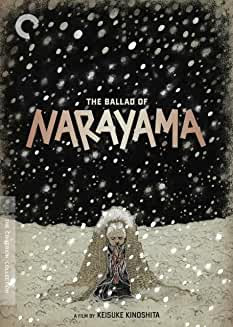
- Commentary: I have seen two of the three filmed versions of this story. The other one I've seen is covered here. Frankly, I wouldn't mind owning both, but the price of the second remains prohibitive. Of the three versions that have been made of this movie, though, this version is my preferred version. It's hard to explain why, considering that the second version referred to above is the more movie-like. This version, aside from telling the story well and totally involving me, is also an experiment in presentation for the filmmaker. For me, it is more jolting than enjoyably somber. The second is more enjoyably somber than jolting. I guess I prefer being jolted, when it comes to this movie.

You'll notice I'm not labeling this movie a "tragedy". That's because, all things considered, it's not. It's a meditation on death, yes, but not tragic death, just death. One of Roger Ebert's Great Movies.
Actor Role Actor Role Actor Role Actor Role Kinuyo Tanaka Orin Teiji Takahashi Tatsuhei Yūko Mochizuki Tamayan Danko Ichikawa Kesakichi Keiko Ogasawara Matsu-yan Seiji Miyaguchi Matayan Yūnosuke Itō Matayan's Son Ken Mitsuda Teruyan
For the Wikipedia write-up on this film, click here.
Release Date: 1958
Directed by Keisuke Kinoshita.
Labels: §2, aging, Criterion1, drama3, haunting1, historical1, period1, psychological1, spiritual1
Make Way for Tomorrow
- Commentary: I first saw this movie the Thanksgiving after my mother died. I was preparing to travel down to the Phoenix metroplex to share a late afternoon Thanksgiving dinner with one of my sisters' families. I awoke early, was ready to go within an hour and looking for something to do until I felt it optimal to leave for the drive down to The Valley. I switched on TCM and up came this movie. I'd never heard of it, but the title intrigued me.

What a film! Despite it having been released in 1937, it addressed a situation so common, today, that the movie industry continues to release a new take on "what-to-do-about-the-elderly" once every couple of years, or so. As a society, here in the U.S., we never get tired of fearing the aging of our parents, and then, our own aging ... and we still don't have it figured out. Every time I watch this movie, I think of a scene out of another movie (which I can't place, at the moment, I don't think I own it), an animated feature, possibly Brother Bear, but I'm not sure, I should rent that movie from the library and see, in which a young character's grandmother features in a short segment, gathering flowers in a forest and explaining the joys of being old. It's a laudable portrayal, but not really true of aging in our society (or some other societies). This movie is true. And depressing. As hell.
Upshot is, I was so impressed with this movie I attempted to talk about it during my Thanksgiving visit. My sister was having none of it. Which kind of proves my point.
With this movie, I'm instituting a new label category, "aging". I'm surprised it didn't exist before this. I guess I share the same psychological malady of having trouble contemplating aging with the rest of my society. Now I'm curious: How many more movies do I own to which this label could apply? Probably not many, which, yet again, underscores my point.
Roger Ebert christened this movie as a "Great Movie", linked to the title of this post.
Actor Role Actor Role Actor Role Actor Role Victor Moore Pa Cooper Beulah Bondi Ma Cooper Fay Bainter Anita Cooper Thomas Mitchell George Cooper Porter Hall Harvey Chase Barbara Read Rhoda Cooper Maurice Moscovitch Max Rubens Elisabeth Risdon Cora Payne Minna Gombel Nellie Chase Ray Meyer Robert Cooper Ralph Remley Bill Payne Louise Beavers Mamie
For the curious, here's the Wikipedia write-up about this film.
Release Date: 1937
Directed by Leo McCarey.

Labels: aging, beulah-bondi, Criterion1, drama3, louise-beavers, psychological1, spiritual1, thomas-mitchell, tragedy1
