Thursday, June 09, 2022
Shutter Island
- Commentary: This movie received highly contradictory critiques, from being considered a high best film of 2010 to being declared not having been worth making. It created so much critical controversy that, aside from triggering more than one critic to produce a review of this movie on RogerEbert.com, there were also several critics who opined about the issues the movie raised for them. The immediately previous link takes you to the simple search I performed for the movie's title, which typically brings up only one review per movie.

I found the movie intriguing, involving, enjoyable and ultimately entertainingly disturbing. It was sent to me by MFS, out of the blue. After I watched the film I wondered why she picked it out for me. I still haven't asked her, but now it doesn't matter. I've watched it three times since I received it. I find that with each viewing, I discover something that I need to bookmark in my mind and pull out on a next watching. In fact, I think I might watch it, again, tonight, now that I'm thinking of it.
Although it appears to have a highly complicated plot, by the end you realize that the complications are solely in the main character's mind, not in yours, which, in a sense, increases the satisfaction in watching it. It is also, for me, a bit scary to watch. After the second watching, I found myself speculating that a similar type of confusion could easily afflict me. I wouldn't have the excuse of murder to drive me to confound myself, but there's enough odd about my life that I can imagine becoming troubled over my deep contemplation of myself and not being able to exit. That is the power of this movie. Although few of us are outright murderers, most of us feel deadly guilty about some incident in our lives. Even my mother had such an incident. When she finally told me what it was, it seemed benign enough to me. It did not involve the murder or even the mistreatment of someone. It involved an incident in which she realized she was unfairly prejudiced against a particular group of people (not because of color, because of religion). It did not involve an opportunity to make direct amends. Upon discovering her prejudice she immediately set about conquering it, but the memory of the discovery haunted her, literally, to her dying day, for a full 40+ years, even though she was successful in understanding and overcoming it.
So, essentially, for me, this movie is a reminder that our monsters, as well as our angels, are just beneath the surface, ready, equally, to take advantage of any opportunity to escape.
Update 6/9/2022: This post was originally published on 8/14/16 but disappeared from public view. I am now reinstating it.
Actor Role Actor Role Actor Role Actor Role Leonardo DiCaprio Edward Daniels Mark Ruffalo Chuck Aule Ben Kingsley Dr. John Cawley Max von Sydow Dr. Jeremiah Naehring Michelle Williams Dolores Chanal Emily Mortimer Nurse Portraying Rachel Solando Patricia Clarkson Rachel Solando Jackie Earle Haley George Noyce John Carroll Lynch 1st Deputy Warden McPherson Joseph Sikora Glen Miga Ted Levine The Warden Elias Koteas Andrew Laeddis Ruby Jerins Little Girl Robin Bartlett Bridget Kearns Curtiss Cook Trey Washington Christopher Denham Peter Breene
Here is the Wikipedia write-up for this film.
Release Date: 2010
Directed by Martin Scorsese.

Labels: ben-kingsley, drama2, dream1, emily-mortimer, leonardo-dicaprio, martin-scorsese, max-von-sydow, mystery1, neo-noirC, psychological1


Raising Buchanan
- Commentary: This movie is a sweet, silly, funny movie. It is, as well, not a movie I would own if I didn't have an actor niece who played a walk-through part in it and a sister who thought to send me a copy of it. I'm also pleased I own it because it is the second to the last movie in which René Auberjonois appeared, whose work I adore. In addition, it won a slew of film festival awards across the U.S., deservedly, I can say, since I've seen it. The crux of the movie is the dilemma of seeking an ill-conceived boost to one's life. It ends poignantly and is thoroughly enjoyable, much to my delight.

Update 6/9/2022: This post was originally published on 1/16/2021 but disappeared from public view. I am now reinstating it.
Actor Role Actor Role Actor Role Actor Role René Auberjonois U.S. President James Buchanan Amanda Melby Ruth Kiesling Cathy Shim Meg Terence Bernie Hines Phillip Crosby M. Emmet Walsh Larry Kiesling Robert Ben Garant Lancaster Guy Jennifer Pfalzgraff Holly Steve Briscoe Errol
Here's the Wikipedia write-up on this movie.
Release Date: 2019
Directed by Bruce Dellis.

Labels: buddy, dramedy1, psychological1, reflective, rené-auberjonois, satire1
Tuesday, March 08, 2022
Safe
- Commentary: I watched this movie today, 3/21/2022. The experience was somewhat unsettling for me, for a few reasons. I don't think I've ever mentioned this before, but when I watch a movie that has a soundtrack of popular music from an era through which I lived and in which I paid particular attention to that popular music, I find it disquieting. This doesn't happen often. Luckily, I don't end up obtaining many movies that have vivid sound tracks with which I personally identify. In the case of this movie, for me, because I was so familiar with the soundtrack and associated it with a very specific time in my life in which I was in my car a lot, listening to the radio, traveling from job to job, hearing the soundtrack took me out of the movie and whipped me back to that time.
Other than that, I thought Julianne Moore's performance was astonishing, the character she played was even more astonishing, and, although I've never lived through such a character crisis, had circumstances been a bit different in my life, had I, for instance, gotten married, kept a home for a family, lived in an environment with very strict behavioral codes, I could imagine myself adopting some of that character's behaviors, just in order to remain standing. This surprised me, as it made me aware of the differences between expression of one's self and the expression of other's expectations of one's role that continues to plague women 35 years after the period of time this movie portrays and 27 years after this movie hit the screens. Todd Haynes, himself, has referred to this movie as a horror film. I would have to agree, and a damned subtle and intriguing horror film, at that, which continues, in my opinion, to seem applicable to the lives of women.
Actor Role Actor Role Actor Role Actor Role Julianne Moore Carol White Peter Friedman Peter Dunning James LeGros Chris Susan Norman Linda
Here's a link to the Wikipedia write-up of the film.
Release Date: 1995
Directed by Todd Haynes.

Labels: Criterion4, dramaE, horror1, julianne-moore, psychological1, women's-movie2
Thursday, January 13, 2022
Pulse (Kairo)
- Commentary: Within the last few weeks when I was doing basic research for this site this movie captured my attention. I'm not sure, but I think I may have encountered it during a discussion of the EMP (electro-magnetic pulse) phenomenon resulting from a nuclear blast on an episode of Super Critical Podcast [the hosts of the episode to which I listened, by the way, are wary of what has been attributed to this phenonmenon]. At any rate, whatever was said piqued my interest and I ordered the movie.
I haven't watched it, yet, and will report back once I do. In the meantime, I discovered that it is listed on TimeOut - Movies's latest (December 10, 2021) compilation of The 100 best horror movies of all time. Since the last time the Wikipedia article on the film (linked immediately below) referenced the list in 2014 this movie has moved up one notch from 66 to 65.
I couldn't help it, by the way. I perused the entire list to see which movies in my collection appear on the list. Here's a rundown. The names of the movies I own are linked to the articles TimeOut - Movies wrote about each movie, including their current ranking (the list is reranked periodically - by the way, TimeOut's The 100 best horror movies of all time list includes two write-ups, the initial for the film as it appears in the list and an additional, different write-up when you click on the title; unfortunately, the html is so convoluted for the list that I couldn't figure out how to link to the initial write-up, so, if you want to access the first write-up, you'll need to scroll through the list; it's usually worth it, until the list is recalibrated, I suppose), after which I linked each to its location on my site:- 82. Midsommar - Midsommar in this journal
- 67. The Witch - The Witch in this journal
- 65. Kairo/Pulse - Pulse (Kairo) in this journal
- 57. The Vanishing - The Vanishing in this journal
- 56. The Sixth Sense - The Sixth Sense in this journal
- 54. Repulsion - Repulsion in this journal
- 39. Jacob's Ladder - Jacob's Ladder in this journal
- 29. The Birds - The Birds in this journal
- 7. Rosemary's Baby - Rosemary's Baby in this journal
You may notice that, in my own labeling, I did not assign the "horror" genre to all these films. I thought about it, as I was compiling this post, but decided to keep my original ranking. Horror is different for different people. Those that I didn't label as horror don't have quite the horrific impact for which I look in a horror film.
Actor Role Actor Role Actor Role Actor Role Kumiko Asō Michi Kudo Haruhiko Kato Ryosuke Kawashima Koyuki Harue Karasawa Kurume Arisaka Junko Sasano Masatoshi Matsuo Toshio Yabe Shinji Takeda Yoshizaki Jun Fubuki Michi's mother Shun Sugata Boss
Here's a link to the Wikipedia write-up of the film.
Release Date: 2001
Directed by Kiyoshi Kurosawa.

Labels: §, apocalyptic, dramaE, folk-horror, psychological1, suspense3
Friday, July 16, 2021
Leave Her to Heaven
- Commentary: I watched this movie last night (7/23/21). I knew nothing about it, which, I think, intensified my reaction (for the better). What an extraordinary movie! Look at all the labels I (legitimately) attached to it! It's got something for everyone, and the entire story [which is, really, a series of stories with one bright red thread (think Ellen's lipstick) running through them] attaches everything that happens to everything else! Yikes!

First of all, Gene Tierney is amazing as the antagonist. The other actors' performances are well turned out, but they are all supportive. The movie belongs to Tierney's character, and, holy jesus, what a character she plays and how well she plays her!
Secondly, when the movie starts, you'll notice it has an odd format: It's full-screen color. Once the movie starts, though, it takes no time to get used to this.
Thirdly, this is not a popcorn-and-soda movie. Go ahead and put out snacks if you want, but, I can guarantee, you will be so riveted from the very beginning to the very end that you'll forget everything except the story, including any food you've supplied.
Finally, the Criterion "special feature" material, both the film essay and the written essay, don't do justice to this movie's singularity. I've seen a lot of movies, in my time, and I am a fan of horror. The only movie I can think of that even approaches the horrific enjoyment I experienced from watching this movie is Midsommar, and, frankly, at this time, fresh from this movie, I can't tell you which I will favor. Perhaps they'll sit atop my horror genre choices in a category of their own.
This is just a gem of a horror movie, in part because it isn't marketed as a horror movie, which was a wise choice by somebody, not sure who. I didn't even realize it was headed in that direction until a little less than half the way through. The story is masterfully manipulated. The settings give absolutely no clue as to what is going to happen. The relationships between the characters start out, and continue for quite awhile, so innocently that you cannot help but be astonished at what is happening, from scene to scene, right before your eyes, and then, when you think you've reached peak astonishment, well, hang onto your hat! No wonder Criterion has this movie in their catalog. It deserves the high honor that a Criterion production confers!
Actor Role Actor Role Actor Role Actor Role Gene Tierney Ellen Berent Harland Cornel Wilde Richard Harland Jeanne Crain Ruth Berent Vincent Price Russell Quinton Mary Philips Mrs. Berent Ray Collins Glen Robie Gene Lockhart Dr. Saunders Reed Hadley Dr. Mason Darryl Hickman Danny Harland Chill Wills Leick Thome Olive Blakeney Mrs. Louise Robie Jim Farley Train Conductor
Here's the link to the Wikipedia write-up of this movie.
Release Date: 1945
Directed by John M. Stahl.

Labels: Criterion2, film-noir3, horror1, legal, melodramaA, popcorn-and-soda6, psychological1, romance4, suspense3, thriller2, tragedy2, violence4
Friday, July 09, 2021
The Bad Seed
- Commentary: Yes, yes, yes. Patty MacCormack and Nancy Kelly's acting was waaay overdone. I think this might have been because both forgot to wash the stage off before they stepped in front of a camera. It also may have happened because the stage play received so much attention that the film director thought keeping stage performance acting would increase interest in the film. And, yes, in places, the story seems so preposterous that even I, alone, at home, watching the movie last night (not my first watching by any means) grinned a lot, and sometimes chuckled aloud. Still and all, this is one movie I love to watch! There is something about watching the story of a perfectly devlish child, regardless of how the story ends. My preference, by the way, is that the child survives, so that I, as a member of the audience, am allowed to speculate on further horrors that child may perpetuate. I am always aware, when I watch the film, that the stage play, in fact, doesn't end with "sweet" Rhoda's death, but, rather, her mother's death, and the assumption that Rhoda continues her murderous life. Considering that it has survived as a novel, a stage play and a couple of movies, including one that is said to have been inspired by it, The Good Son, I suspect I am not the only person with this preference, since the change of ending for the film was not dictated by a clear thinking director but by the Production Code Administration.

I'm not sure I understand what the appeal of devlish children is. Perhaps it has something to do with all the anger toward life one acquires in childhood that is never resolved and, after childhood, never really thought about, again, and, yet, does not simply disappear. Which is, I think, precisely why there is so much psycho-babble in the script, often through the character of "Aunt Monica" (excellently played by the way, in the movie).
I was surprised that the edition I purchased was widescreen. I have memories of watching this on TV in full screen rather than widescreen. Those memories, though, may be erroneous.
You might also find TCM's notes on the film interesting, rather than my usual Wikipedia article, although, if you're curious, you can find Wikipedia's write-up here.
Quick Administrative Note: This movie is the first in my collection to which I've applied the label "melodrama". I was surprised to discover that I've never used that label and had to add it to my label list. I guess that means I don't have, nor am I attracted to, melodramatic movies. Except this one. The fact that it's a melodrama is what makes it so much fun!
There is something alluring about this film. It's one I've checked out of our public library occasionally in the past several years. It's one I watched on TV with my mom when she was alive, who, by the way, enjoyed it, too, despite her pure soul, love of children and having been an enthusiastic, top-flight teacher of older elementary school children. In the Wikipedia article about this film there is an "Analysis" comparing the this movie with The Good Son. It's short, but interesting, and may, in part, explain the durability of this film and the idea behind it. And, yes. I found a free copy of the novel, downloaded it, and intend to read it one of these sooner days, just because, well, I want to know if the novel speaks about childhood wickedness in the same way the play and the movie do.
Actor Role Actor Role Actor Role Actor Role Patty McCormack Rhoda Penmark Nancy Kelly Christine Penmark William Hopper Col. Kenneth Penmark Henry Jones Leroy Eileen Heckart Mrs. Hortense Daigle Frank Cady Henry Daigle Jesse White Emory Shelley Fabares Margie
Release Date: 1956
Directed by Mervyn LeRoy.

Labels: film-noir3, henry-jones, horror1, melodramaA, psychological1
Tuesday, May 25, 2021
The Attack
- Commentary: Curiously, the Wikipedia page for this movie is a sad affair. It contains not even a plot summary, just a list of the cast, some links to other films by Ziad Doueiri and a list of "External Links" to critical sites that write about this movie. In fact, there is more written about this film in the Wikipedia write-up for Zaid Doueiri, the director, than there is in Wikipedia's write-up about the movie.
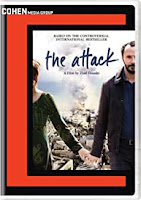
I do not remember when I first saw this movie, or how. It was certainly between 2012 and now, probably on a streaming service, definitely at no charge. It seems to me that it may have been within the last five years. I also have a vague recollection of watching it at least twice, perhaps more.
This is a haunting movie that I should have included in my list of Movies I've Seen, Do Not Own but Can't Forget, as I think about it often. This movie lays out a peculiar story about a Palestinian-Islamic physician practicing in Israel whose Palestinian Orthodox Catholic wife is killed in a terrorist bombing. The physician discovers something about his wife's death that horrifies and befuddles him. The bulk of the movie documents his journey to understand her and Israel's and Palestine's roles in her death.
There are no simple answers in this movie, for either the physician or the audience. It will keep you ruminating about The Human Condition long after you've completed watching the movie. In this sense, it is a priviledge for every member of the audience to be invited along on this physician's journey to discover the truth about his wife's life and death, and more. The number of labels I've appended to this film should be an indication of its overwhelming impact.
Finally, if you are in doubt about the impact this film may have on you, read this eloquent review by someone unknown to me who was also gob-smacked by this film.
Warning: This is not a popcorn-and-soda movie. Prepare to be moved, not entertained.
Actor Role Actor Role Actor Role Actor Role Ali Suliman Amin Jaafari Reymond Amsalem Siham Jaafari Evgenia Dodina Kim Dvir Benedek Raveed Uri Gavriel Captain Moshe Ruba Salameh Faten Karim Saleh Adel Nisrin Siksik Leila Bassem Lulu Yasser Ezra Dagan Ezra Benhaim Ramzi Maqdisi Priest Arieh Worthalter The Man
Release Date: 2012
Directed by Ziad Doueiri.

Labels: drama1, film-art1, haunting1, me-favorite1, mystery1, political1, psychological1, reflective, spiritual1, tragedy1, violence1
Saturday, May 22, 2021
The Wrong Man
- Commentary: This movie was originally listed in the post Movies I've Seen, Do Not Own but Can't Forget. It was the first movie listed. As of today, I own it. Although I'll write more once I've watched the movie as my property (which I expect to do tonight), in the meantime I want to append what I wrote when I was jonesing for this movie:

I saw this movie, initially, with my mom, probably on TCM, since, during her life, we had a cable TV subscription. It's been over a decade since I've had access to TCM, but it hasn't been that long since I've seen this movie. It initially intrigued me because I have had dental problems all my life. As a non-dependent adult, some of those problems have been exacerbated because dental care is too expensive for me to afford. This is part of the initial reason why Henry Fonda's character in this movie ends up in a position to be mis-identified by the police. Although the rest of the movie is thoroughly engrossing, this minor fact is what drew me into watching this movie more than once. I was, frankly, gob-smacked that inability to afford dental care was a rampant problem in 1956! Everyone, in these days of rallying for Medicare for All, rants about the disgusting inequity of health care in the U.S. Why does no one, anywhere in the world, rant about the long-standing unaffordability of dental care?
There. That's done. More later.
Update 5/24/21: After having watched this movie last night, start to finish, I'm not sure I ever watched it in its entirety before. I discovered that I didn't remember quite a bit of it.
What a movie! The story is subtly told. Henry Fonda's performance is appropriately understated. For most of the movie he looks like Everyman in a Stupor, and that's not a dis, that's a high compliment, as, how else could one look as someone who is, indeed, "The Wrong Man"?!? Balestrero, as played by Fonda, when being confronted by this absurd accusation, never, ever looks like he finally "gets it". When he is pulled back into his normal life, as he is often throughout the film, he looks and acts and appears to think like a normal working guy with a wife and family. When he becomes The Wrongly Accused, he is perpetually dumbfounded. It is hard not to think that, if he had not had a normal, job-home-family life to consistently fall back into, he would have gone as crazy as his wife. The three main lighting contrasts, sharp-dark for the accusation scenes, brightly lit for the home and personal investigative scenes and a kind of anticipatory light gray for the courtroom and lawyer's office scenes, are revelatory in themselves. The scenes with his lawyer and in the courtroom are especially delicious because he is in a legal situation in which he has no way of helping himself, and this is dramatised beautifully.
I have to say, after watching it last night I think, if I had watched the movie before, it was likely snippets, during my companionship with my mother, never beginning to end, as I experienced it last night. It's impossible not to feel the jaws of a trap not set for Balestrero closing around Balestrero's soul.
I have to admit to some disbelief of Rose Balestrero's reaction, although, since it's the telling of a true story, I suppose her reaction and her subsequent predicament happened. Perhaps I was raised in the wrong era. I can not only not imagine myself reacting that way to my husband being wrongly accused and tried, I know no one for whom Rose Balestrero's behavior would emerge in any situation, let alone one like this. I wonder if that's one of the differences of women being raised in an environment that emphasizes domesticity versus my having been raised in an environment that emphasized women's full participation in society (despite the fact that this was only partially achieved).
Wonderful production, astonishing story (which the epilogue makes clear is, in fact, a true story), well acted, well staged, well directed, well produced, well done! This may not be the scariest movie Hitchcock ever made (although I'm willing to bet that, for people who have been through similar circumstances, it might be, and, as well, it packs the extra punch of being true), but it's way up there. Bravo, Alfred!
Actor Role Actor Role Actor Role Actor Role Henry Fonda Christopher Emmanuel Balestrero Vera Miles Rose Balestrero Anthony Quayle Frank O'Connor Harold J. Stone Det. Lt. Bowers Charles Cooper Det. Matthews John Hildebrand Tomasini Esther Minciotti Mama Balestrero Doreen Lang Ann James Laurinda Barrett Constance Willis Norma Connolly Betty Todd Nehemiah Persoff Gene Conforti Lola D'Annunzio Olga Conforti Werner Klemperer Dr. Bannay Bonnie Franklin Young Girl Tuesday Weld Giggly Girl Harry Dean Stanton Dept. of Corrections Employee
Here's the Wikipedia write-up on the movie.
Release Date: 1956
Directed by Alfred Hitchcock.

Labels: alfred-hitchcock, drama1, film-noir1, harry-dean-stanton, henry-fonda, melodramaC, mystery1, nehemiah-persoff, psychological1, suspense1, thriller1, tuesday-weld
Monday, April 05, 2021
The Witch
- Commentary: I finally watched this film last night, 6/30/21. I know. I've had it since April. My only excuse is that, although since that time I've added several movies (seen and unseen previous to purchase) I've wanted to own, at the same time I entered into a period, not the first I've experienced, when I just didn't want to spend much time staring at the screen, no matter how much any particular movie excited me.

Anyway, interesting, interesting film! First of all, there's not a false performance in it. Second, the setting is exquisitely managed. Third, the story, itself, slips, expertly between "witches, yes" and "witches, no". Third, character development and relational portrayal between characters are never neglected. I ended the movie with no questions or holes in my understanding. In addition, my attention was riveted from beginning to end.
Truthfully, having been born on Halloween, I have a special relationship with horror movies that focus on witchery. I have, by no means, seen all of them and tend to avoid the hundreds (if not thousands) of horror films, witched or not, that cluster-release around Halloween. This movie, though, is designed, I think, to be thought provoking and decidedly eerie any time of the year, especially since it unfolds slowly. Impressive job for a directoral first. It would, in fact, be an excellent job for a film made in the middle or end of a long film-making career.
Actor Role Actor Role Actor Role Actor Role Anya Taylor-Joy Thomasin Ralph Ineson William Kate Dickie Katherine Harvey Scrimshaw Caleb Ellie Grainger Mercy Lucas Dawson Jonas Julian Richings The Governor Bathsheba Garnett The Old Witch Sarah Stephens The Young Witch Charlie Goat Black Phillip Wahab Chaudhry Human Black Phillip Axtun & Athan Dube Samuel
Here's the Wikipeda write-up on this film.
Release Date: 2015
Directed by Robert Eggers.

Labels: A24, drama1, feminist, folk-horror, period1, popcorn-and-soda1, psychological1, spiritual1, women's-movie2
Sunday, January 17, 2021
The Dark Knight Trilogy: Batman Begins
- Commentary: This is an endlessly interesting origin story for Batman. All the major characters that people Christopher Nolan's Dark Knight Trilogy are introduced, including Batman as a boy and how, exactly, the death of his parents leads him to become Batman. No need to say anymore, except, I'm a fan of the entire trilogy.
Actor Role Actor Role Actor Role Actor Role Christian Bale Bruce Wayne/Batman Linus Roache Thomas Wayne Sara Stewart Martha Wayne Morgan Freeman Lucius Fox Michael Caine Alfred Pennyworth Liam Neeson Henri Ducard/Ra's al Ghul Katie Holmes Rachel Dawes Gary Oldman James Gordon Cillian Murphy Dr. Jonathan Crane/Scarecrow Tom Wilkinson Carmine Falcone Rutger Hauer William Earle Ken Watanabe decoy Ra's al Ghul
Here's a link to the Wikipedia write-up for this movie.
Release Date: 2005
Directed by Christopher Nolan.

Labels: action2, adventure2, christian-bale, christopher-nolan, coming-of-age1, drama1, michael-caine, morgan-freeman, neo-noirB, psychological1, super-hero1, suspense1, tom-wilkinson, violence1
Repulsion
- Commentary: Under construction.

Actor Role Actor Role Actor Role Actor Role Catherine Deneuve Carol Ledoux Ian Hendry Michael John Fraser Colin Yvonne Furneaux Helen Ledoux Patrick Wymark Landlord Renée Houston Miss Balch Valerie Taylor Madame Denise James Villiers John Helen Fraser Bridget Hugh Futcher Reggie Monica Merlin Mrs. Rendlesham Imogen Graham Manicurist
Here's the link to the Wikipedia write-up of this movie.
Release Date: 1965
Directed by Roman Polanski.

Labels: §1, Criterion1, horror2, neo-noirA, psychological1, roman-polanski
Saturday, January 16, 2021
Falling Down
- Commentary: I almost feel like I have to explain my affection for this movie. Michael Douglas portrays such a tortured, confused character, one with whom I don't identify. And, yet, in my opinion, he plays it brilliantly and the story within which he unfolds this character is believable and thrilling. Initially, I think he was brave to take on this role. On second and third thought, though, Michael Douglas is refreshingly ready to surprise his audience with the range of the characters he takes on. This is one of his more complicated characters. For me, it's a Michael Douglas coup. I am always ready to watch this movie, which is why I have it in my collection.
One last mention: Roger Ebert wrote an interesting article about the rise of Donald Trump (pre-election) that used four different movies as grist for his mill. It's quite interesting. This movie is one of his four. And, BTW, all the movies he mentioned are in my collection and are favorites of mine. Who'd-a-thunk!
Actor Role Actor Role Actor Role Actor Role Michael Douglas William Foster Robert Duvall Sgt. Martin Prendergast Barbara Hershey Beth Trevino Rachel Ticotin Det. Sandra Torres Tuesday Weld Amanda Prendergast Frederic Forrest Nick Lois Smith Foster's Mother Joey Hope Singer Adele Foster-Trevino Michael Paul Chan Mr. Lee Raymond J. Barry Cpt. Bill Yardley D. W. Moffett Det. Lydecker Steve Park Det. Brian
Here is the Wikipedia article on this film.
Release Date: 1993
Directed by Joel Schumacher.

Labels: action2, adventure2, barbara-hershey, drama1, economic, haunting1, lois-smith, michael-douglas, political1, psychological1, robert-duvall, satire1, thriller1, tragedy1, tuesday-weld, violence1
Wednesday, August 05, 2020
Valley of the Dolls
- Commentary: Yes, I read the book. Decades ago. When I was a teenager. When it was, sort of, taboo literature for girls my age. I also saw the movie when I was a teenager, and have seen it several times since, when it's been featured on some TV channel. It's hard to describe what kind of a hold this movie has over me; why, for instance, I so enjoy watching the turgid stories of these three young women and their torrid lives. I can tell you that I never considered owning this movie until I noticed that Criterion had put out an edition of it with loads of special features. "Ah ha!" I thought. "This edition will help me explain to myself my fascination with this movie!" I'm not sure that's what happened, but I can tell you that I spent an entire afternoon indulging in the movie and each one of the special features, including reading the accompanying booklet cover to cover.
This movie is the ultimate chick flick. Although the focus is supposed to be on the "dolls", the pills that these women consume in order to follow their dreams, the truth is the pills are incidental. The bonus material often refers to it as "camp", but, I can tell you, its campiness is not why I love this movie. I don't love it because it reminds me of the decade of the 1960s. Frankly, even though I was a teenager during that decade, I was pretty much a bookish girl-woman who lived a life that could have been described, from the outside, as dull. I didn't have glorious dreams like the women in this movie. I love the movie because I love reveling in the stories of embattled chicks, whether they're on "dolls" or not. There. I said it.
You'll notice I've labeled it as both a "pussy-flick" and a "women's movie". For me, it's both. It is not a "20th-century-chick-flick", as none of the romances follow that particular type of romantic story. Nobody ends up with their man. It contains scenes that are so full of pathos they can only be described as pathetic and scenes that are touching and thoughtful. It contains a lot of other scenes that are, frankly, just plain cheesy. Sometimes, too, those cheesy scenes are so over-scripted that, while you're watching, you know you're supposed to find them moving but you can't help but giggle, even if you're watching the movie alone. Ah, but those scenes are, dare I say it, the most fun!
Finally, yes, it's true, Roger Ebert was mildly disgusted by this movie (I say "mildly" because he gave it two stars, rather than one). So, he and Russ Meyer co-wrote what they intended as a parody, Beyond the Valley of the Dolls. I never saw that movie, although, apparently, according to Wikipedia, it duplicated the fate of the original, first ignored, then loved, then culted and partially reappraised. Roger Ebert even wrote an explanatory review of Beyond the Valley of the Dolls. I didn't read the review, only skimmed it. I probably won't ever see this movie, but, you know, if you can't beat 'em, I guess ...
Thank you, Criterion! A master coup!
Actor Role Actor Role Actor Role Actor Role Barbara Parkins Anne Wells Patty Duke Neely O'Hara Paul Burke Lyon Burke Sharon Tate Jennifer North Tony Scotti Tony Polar Lee Grant Miriam Polar Susan Hayward Helen Lawson Martin Milner Mel Anderson Alexander Davion Ted Casablanca Jacqueline Susann Reporter #1 Richard Dreyfuss Asst. Stage Mgr. Judith Lowry Aunt Amy
Here, as usual, is the Wikipedia write-up of this movie.
Release Date: 1967
Directed by Mark Robson.

Labels: 20th-century-chick-flicks1, buddy, Criterion1, drama2, fantasy1, me-favorite1, popcorn-and-soda1, psychological1, pussy-flick, richard-dreyfuss, romance1, tragedy1, women's-movie1
Tuesday, November 05, 2019
Ace in the Hole
- Commentary: I didn't know anything about this film when I first checked it out for viewing. I was on a binge, at the time, of watching movies that were made the year I was born and this was one of them. I barely remember any of the other movies I found (not a lot; our county library system is a bit short of 1951 films, even though there were plenty made, according to this list, 1,744, to be exact). This was not the only 1951 movie Kirk Douglas made, and it's not the only 1951 movie I own, but it's a doozy.

If you think the late 1960's through the early-to-mid 1970's had the bead on socially relevant movies, watch this one. The behavior depicted (brilliantly, in my estimation) in this film is so ubiquitous, now-a-days, not only by individual journalists (of which there are many Chuck Tatums) but by entire media corporations, that many don't even realize there is a problem ... until, that is, they watch this 68 year old movie. If you entertain, even a little bit, a healthy skepticism of today's media, you should treat yourself to this movie.
Actor Role Actor Role Actor Role Actor Role Kirk Douglas Chuck Tatum Jan Sterling Kirk Douglas Kirk Douglas Herbie Cook Porter Hall Jacob Q. Boot Frank Cady Mr. Federber Richard Benedict Leo Minosa Ray Teal Sheriff Kretzer Lewis Martin McCardle John Berkes Papa Minosa Frances Dominguez Mama Minosa Gene Evans Deputy Sheriff Frank Jaquet Sam Smollett Harry Harvey Sr. Dr. Hilton Bob Bumpas Radio Announcer Richard Gaines Nagel Bert Moorhouse Josh Morgan
One of Roger Ebert's Great Movies.
Here's the link to the Wikipedia write-up for this film.
Release Date: 1951
Directed by Billy Wilder.

Labels: birth-year, Criterion1, drama2, film-noir1, journalism, kirk-douglas, melodramaB, political1, psychological1, suspense1
Tokyo Story
- Commentary: This movie is the Japanese version of Make Way for Tomorrow. Literally. Ozu admitted, at one time, that he was influenced by Make Way for Tomorrow to create this movie. This is also my favorite Ozu film, if I can be said to have a favorite. I also love Ikiru, although I don't own it (yet), and, of course, I do own An Autumn Afternoon, which I also love. Ozu had a way with the subject of aging. Tokyo Story is never maudlin, never particularly editorial (although, of course, fiercely editorial in the choice of subject matter). Tokyo Story is also not pointedly about aging, but, rather, about inter-generational conflict when aging is involved. And yet, despite its trajectory, it does not strike me as tragic. Perhaps that's because I was my mother's enthusiastic companion through her last almost two decades and subtly nurtured her amazing belief that she was going to live forever in the flesh. She, by the way, informed me that I would also live forever in the flesh, a prophecy that I happily embraced. Are you kidding? The two of us living, together, forever? Oh, my what adventures we'd have (to misquote Dr. Seuss)!

Roger Ebert was so impressed with the movie that he wrote two reviews of it: the second, a "Great Movies" review, linked to the title of this post and the first, his review after the first time he saw it, which is linked a bit further down in this post. They are somewhat similar, but I think any readers will get a kick out of comparing the two.
In addition, the cinematography and the choices made in regard to connecting scenes are intuitively brilliant, from my perspective. The mood is preserved, throughout, by these delicate, connecting links in the chain of the story.
Actor Role Actor Role Actor Role Actor Role Chishū Ryū Shūkichi Hirayama Chieko Higashiyama Tami Hirayama Setsuko Hara Noriko Hirayama Haruko Sugimura Shige Kaneko So Yamamura Kōichi Hirayama Kuniko Miyake Fumiko Hirayama Kyōko Kagawa Kyōko Hirayama Eijirō Tōno Sanpei Numata Nobuo Nakamura Kurazō Kaneko Shirō Ōsaka Keizō Hirayama Hisao Toake Osamu Hattori Teruko Nagaoka Yone Hattori
Here's a link to the Wikipedia write-up of the film.
Release Date: 1953
Directed by Yasujirō Ozu.

Labels: §1, aging, chishū-ryū, Criterion1, drama2, film-art1, psychological1, spiritual1, yasujirō-ozu
The Ballad of Narayama
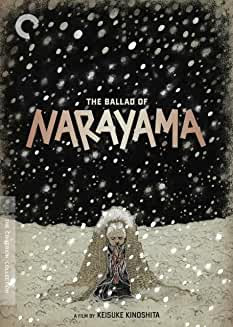
- Commentary: I have seen two of the three filmed versions of this story. The other one I've seen is covered here. Frankly, I wouldn't mind owning both, but the price of the second remains prohibitive. Of the three versions that have been made of this movie, though, this version is my preferred version. It's hard to explain why, considering that the second version referred to above is the more movie-like. This version, aside from telling the story well and totally involving me, is also an experiment in presentation for the filmmaker. For me, it is more jolting than enjoyably somber. The second is more enjoyably somber than jolting. I guess I prefer being jolted, when it comes to this movie.
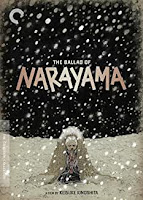
You'll notice I'm not labeling this movie a "tragedy". That's because, all things considered, it's not. It's a meditation on death, yes, but not tragic death, just death. One of Roger Ebert's Great Movies.
Actor Role Actor Role Actor Role Actor Role Kinuyo Tanaka Orin Teiji Takahashi Tatsuhei Yūko Mochizuki Tamayan Danko Ichikawa Kesakichi Keiko Ogasawara Matsu-yan Seiji Miyaguchi Matayan Yūnosuke Itō Matayan's Son Ken Mitsuda Teruyan
For the Wikipedia write-up on this film, click here.
Release Date: 1958
Directed by Keisuke Kinoshita.
Labels: §2, aging, Criterion1, drama3, haunting1, historical1, period1, psychological1, spiritual1
Make Way for Tomorrow
- Commentary: I first saw this movie the Thanksgiving after my mother died. I was preparing to travel down to the Phoenix metroplex to share a late afternoon Thanksgiving dinner with one of my sisters' families. I awoke early, was ready to go within an hour and looking for something to do until I felt it optimal to leave for the drive down to The Valley. I switched on TCM and up came this movie. I'd never heard of it, but the title intrigued me.

What a film! Despite it having been released in 1937, it addressed a situation so common, today, that the movie industry continues to release a new take on "what-to-do-about-the-elderly" once every couple of years, or so. As a society, here in the U.S., we never get tired of fearing the aging of our parents, and then, our own aging ... and we still don't have it figured out. Every time I watch this movie, I think of a scene out of another movie (which I can't place, at the moment, I don't think I own it), an animated feature, possibly Brother Bear, but I'm not sure, I should rent that movie from the library and see, in which a young character's grandmother features in a short segment, gathering flowers in a forest and explaining the joys of being old. It's a laudable portrayal, but not really true of aging in our society (or some other societies). This movie is true. And depressing. As hell.
Upshot is, I was so impressed with this movie I attempted to talk about it during my Thanksgiving visit. My sister was having none of it. Which kind of proves my point.
With this movie, I'm instituting a new label category, "aging". I'm surprised it didn't exist before this. I guess I share the same psychological malady of having trouble contemplating aging with the rest of my society. Now I'm curious: How many more movies do I own to which this label could apply? Probably not many, which, yet again, underscores my point.
Roger Ebert christened this movie as a "Great Movie", linked to the title of this post.
Actor Role Actor Role Actor Role Actor Role Victor Moore Pa Cooper Beulah Bondi Ma Cooper Fay Bainter Anita Cooper Thomas Mitchell George Cooper Porter Hall Harvey Chase Barbara Read Rhoda Cooper Maurice Moscovitch Max Rubens Elisabeth Risdon Cora Payne Minna Gombel Nellie Chase Ray Meyer Robert Cooper Ralph Remley Bill Payne Louise Beavers Mamie
For the curious, here's the Wikipedia write-up about this film.
Release Date: 1937
Directed by Leo McCarey.

Labels: aging, beulah-bondi, Criterion1, drama3, louise-beavers, psychological1, spiritual1, thomas-mitchell, tragedy1
Friday, September 13, 2019
Dolores Claiborne
- Commentary: Did you know that the material in this movie is not only a book written by Stephen King, but inspired an opera, as well? I'm not surprised. The themes are sturdy, well-portrayed with a lack of sentimentality and an abundance of complication and so incredibly well acted and ever-inspiring: mother vs daughter, employee vs employer, wife vs abusive husband, community vs stalwart, self-protective woman. I swear, someday, when you and I are long dead, Stephen King will be considered the Shakespeare of our age.

This movie has had a hold on me for years. I purchased it because I've checked it out of our library system so many times I believe I am partly responsible for the fact that at least one copy is always being "mended" by the staff. That's why I own it, now.
There is only one aspect of the story with which I quibble: Dolores inheriting Vera's estate. On the one hand, she certainly deserves it, the inheritance places Vera in a kinder light, and Dolores' character certainly isn't changed by the news of the inheritance, although I suspect her circumstances are. On the other hand, you know, every time I watch this movie, I imagine Dolores not inheriting and realize, yet again, it wouldn't matter to the overall effect of the movie and the story. At any rate, it's a tiny quibble I have. Doesn't change my undying love for this movie, this character and the character of Vera.
Actor Role Actor Role Actor Role Actor Role Kathy Bates Dolores Claiborne Jennifer Jason Leigh Selena St. George Judy Parfitt Vera Donovan Christopher Plummer Det. John Mackey David Strathairn Joe St. George Eric Bogosian Peter John C. Reilly Cons. Frank Stamshaw Bob Gunton Mr. Pease
The Wikipedia write-up for this movie (not the opera, that's earlier in this post) is here.
Release Date: 1995
Directed by Taylor Hackford.

Labels: bob-gunton, christopher-plummer, david-strathairn, drama3, haunting1, jennifer-jason-leigh, journalism, period1, psychological1, taylor-hackford, tragedy1, women's-movie1
Thursday, August 08, 2019
The Three Faces of Eve
- Commentary: What actor doesn't love a chance to display their skills by playing a character with DID (Dissociative Personality Disorder - Multiple Personality Disorder)? Many try; a surprising number succeed. After all, what is an actor but someone who has the desire and the ability to take on character after character after character ... which accounts for the fact that, having seen many of these movies (and owning a few), I can't recall ever seeing a bad one. The Three Faces of Eve with Joanne Woodward was made in 1957 and continues to show up on lists with titles like "The [Number] Best DID Movies". Yes Virginia, there are such lists, scads of them, I just discovered. Before I wrote up this movie, I couldn't help but recall that Split is such a movie, and that, throughout my life, I can remember several actors playing DID people. A few of the articles include certain superhero characters in the DID category. This had never occurred to me, but, surely, The Hulk would qualify.

So, anyway, Joanne Woodward in The Three Faces of Eve is neither the first, nor the last actor to take on multiple-characters-in-one, but she certainly turned in a fine performance [or, would that be "performance'S'"?]. Yes, I've seen this movie before, and, although this movie isn't the reason I bought the four-pack, it's certainly an attractive addition. Characterizations of multiple characters are guaranteed to be poignant, for better and worse, but, if my memory serves me correctly, this is one of the better poignant performances of such a disorder.
Update 1/12/21: A few days ago I noticed this missing from the four pack of movies which included this one. At first I figured I must have misfiled it in another movie jacket and mildly despaired at trying to find it among the hundreds of movie jackets I own. Then, yesterday, I recovered a faint memory of giving it to one of my nieces a few years ago, the one who is an actress. I even recall, at the time, thinking she'd really enjoy it, where as I probably wouldn't watch it, again, even though I didn't dislike it; I was, however, put off by the melodramatic aspects of the movie. I'll have to check with her. I hope I'm right about this. If not, well, who knows how long it will take me to discover where I misfiled it!
Update 3/29/21: I finally found this movie, lurking in a blu-ray case I'd bought for splitting collections into separate movies. Why I'd taken this out of it's original collection case and placed it in it's own case without doing that to the others, I'll never know, but, oh, well, I've found it now.
Actor Role Actor Role Actor Role Actor Role Joanne Woodward Eve White/Eve Black/Jane David Wayne Ralph White Lee J. Cobb Dr. Curtis Luther Edwin Jerome Dr. Francis Day Alena Murray Secretary Nancy Kulp Mrs. Black Douglas Spencer Mr. White Alistair Cooke Narrator
Here's a link to the Wikipedia write-up of the film.
Release Date: 1957
Directed by Nunnally Johnson.

Labels: drama3, haunting1, joanne-woodward, lee-j-cobb, popcorn-and-soda1, psychological1
